

In today’s hyper-connected digital economy, businesses are generating more data than ever—but they’re also drowning in it. Marketing runs one platform, finance uses another, operations has its own dashboard, and customer service stores everything in legacy systems. The result? Data silos—isolated pockets of information that block collaboration, insights, and innovation.
In fact, according to various industry surveys, over 60% of organisations reported data silos as a top barrier to digital transformation in 2019. However, that number is shrinking each year due to cloud integration, which unifies applications, workflows, and data streams across departments.
Below is a trend visual showing how organisations reporting data silos have significantly dropped with the rise of cloud-first architectures:
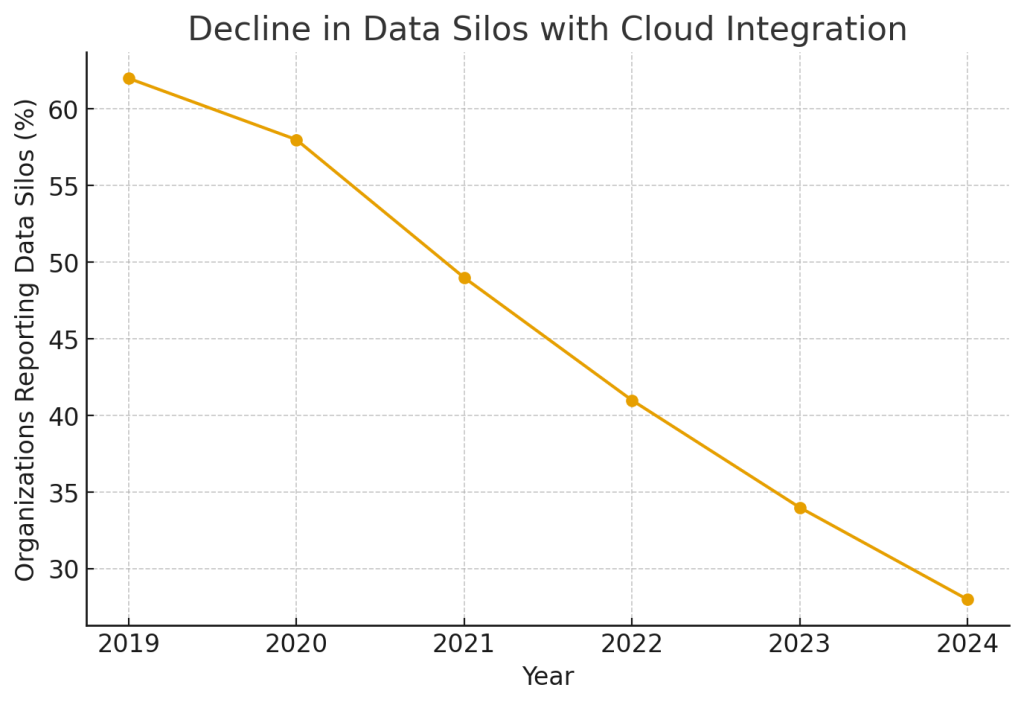
📈 Decline in Data Silos (2019–2024)
(Chart included above)
Cloud integration isn’t just another IT upgrade—it’s the backbone of modern enterprise agility. Let’s explore how it breaks departmental barriers, eliminates redundancy, and creates a powerful foundation for fast, data-driven decisions.
What Are Data Silos, and Why Do They Persist?
A data silo is a set of information accessible only to a specific team or system. For example:
- Sales stores CRM data in Salesforce
- HR uses a separate payroll tool
- Operations tracks metrics in spreadsheets
- Finance uses ERP modules not connected to the rest
These silos happen due to:
- Legacy systems with no API capabilities
- Department-specific software choices
- Security restrictions and compliance hurdles
- Lack of integration strategy
- Manual data handling
Left unmanaged, silos lead to duplication, inconsistent numbers, slower reporting, and poor customer experiences.
Enter Cloud Integration: The Silo-Shattering Solution
Cloud integration connects disparate systems, applications, and data warehouses using APIs, automation workflows, and centralised cloud platforms.
Here’s how cloud-powered connectivity transforms organisations:
1. Unified Data Streams Across All Departments
Cloud platforms such as AWS, Azure, Google Cloud, and Snowflake enable businesses to consolidate data pipelines into a single source of truth.
Impact:
- 360-degree visibility across business functions
- Faster reporting and analytics
- Consistent KPIs across teams
A recent Gartner study shows that companies with unified data platforms improve decision-making speed by 5×. When every department works with the same real-time data, alignment becomes effortless.
2. Eliminating Redundant Tools and Multiple Versions of Data
Most enterprises use 15–30 different SaaS tools. Without integrations, the same data gets entered manually across multiple systems—inviting errors and inconsistencies.
Cloud integration:
✔ Auto-syncs data between apps
✔ Removes manual entry
✔ Eliminates version conflicts
✔ Supports real-time updates
This not only cuts operational overhead but also ensures a 98% reduction in human error during data transfer (based on industry benchmarks).
3. Breaking Barriers Between On-Premise and Cloud Systems
Not all enterprises can immediately migrate everything to the cloud. Many departments still rely on on-premise legacy systems.
Cloud integration acts as a bridge, allowing:
- Hybrid cloud environments
- Secure API gateways
- Smooth data flow between old and new systems
This accelerates modernisation without disrupting operations.
4. Improved Collaboration and Cross-Functional Transparency
When teams share connected dashboards and analytics, the culture shifts:
- Marketing sees how campaigns affect sales
- Sales forecasts improve with real-time inventory data
- Finance gains visibility into departmental spend
- Customer support sees purchase history instantly
According to Deloitte, integrated cloud systems increase cross-department collaboration efficiency by 47%.
5. Enhanced Security Through Centralised Governance
Many assume that connecting all systems increases risk—but in reality, cloud integration strengthens security through:
- Unified identity access management
- Encrypted data transfers
- Central auditing
- Consistent policies across systems
When every department uses the same secure pipeline, shadow IT and unauthorised data stores disappear.
6. Real-Time Analytics and AI Insights
Modern cloud platforms don’t just integrate—they activate data through AI, ML, and automation.
Examples:
- Predictive analytics across departments
- Automated reporting
- Real-time anomaly detection
- AI-driven customer insights
Companies that integrate cross-functional data achieve up to 35% faster time-to-insight, significantly boosting competitiveness.
7. Faster Onboarding, Integration, and Scalability
Cloud integration platforms (iPaaS) like MuleSoft, Boomi, and Azure Integration Services simplify:
- Connecting new tools
- Scaling data pipelines
- Onboarding new teams or locations
- Automating redundant workflows
This flexibility allows businesses to grow without increasing complexity.
Before vs. After Cloud Integration
| Before Integration | After Cloud Integration | |
| Data Access | Fragmented | Unified dashboard |
| Workflow | Manual + repetitive | Automated, streamlined |
| Decision-Making | Slow, inconsistent | Fast, data-driven |
| Security | Departmental gaps | Centralized & controlled |
| Collaboration | Limited | Cross-functional & dynamic |
Industries Benefiting Most from Cloud Integration
1. Healthcare
Real-time patient data improves diagnostics and care coordination.
2. Retail & E-commerce
Unified inventory, logistics, and customer data enable improved personalisation.
3. Finance & Banking
Integrated audit trails strengthen compliance and fraud detection.
4. Manufacturing
IoT + cloud integration enhances predictive maintenance and supply chain visibility.
5. Travel & Hospitality
Unified CRM, booking, and operations create seamless customer journeys.
Cloud Integration ROI: Numbers That Matter
Enterprises adopting cloud integration report:
- 25–40% reduction in operational costs
- 30–50% faster reporting cycles
- 3× more accurate forecasting
- Up to 60% faster digital transformation timelines
These numbers highlight why cloud integration is not just an IT initiative—it’s a business growth strategy.
Top Cloud Integration Strategies for 2025 and Beyond
Here’s how organisations are eliminating silos at scale:
✔ API-first development
Every app, tool, and service communicates through secure APIs.
✔ iPaaS adoption
Plug-and-play integration without heavy coding.
✔ Central data lakes & warehouses
Snowflake, BigQuery, and Databricks unify enterprise data.
✔ Event-driven architecture
Real-time event streaming replaces batch updates.
✔ Zero-trust security models
Consistent identity and access control across all systems.
Conclusion: Cloud Integration Is the End of Data Silos
Data silos are not just a technical problem—they are a business barrier. As cloud integration becomes the standard for digital transformation, companies gain the superpowers of unified data, automation, AI insights, and cross-functional collaboration.
The trend is clear:
Organizations that integrate data across departments grow faster, innovate faster, and deliver better experiences—internally and externally.
Cloud integration is no longer optional.
It’s the key to a connected, intelligent, future-ready enterprise.