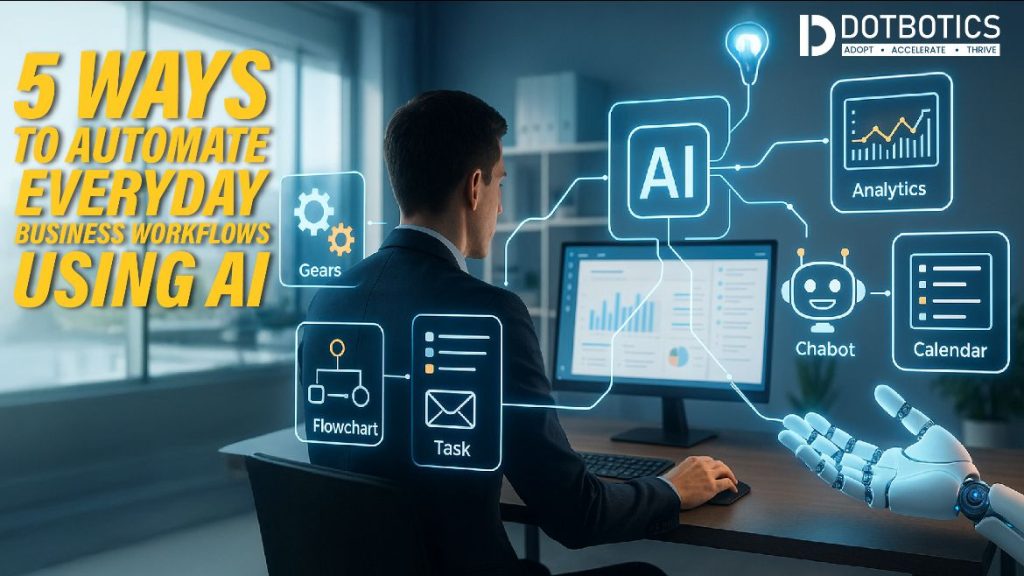
In today’s fast-moving business environment, efficiency isn’t just a competitive advantage — it’s a necessity. As organizations handle increasing amounts of data, communication, and decision-making, manual workflows have become a major bottleneck. That’s where Artificial Intelligence (AI) steps in.
AI-driven automation is transforming how teams operate — from sales and marketing to HR and operations. By automating repetitive, time-consuming tasks, AI enables employees to focus on higher-value work that drives innovation and growth.
In this blog, we’ll explore five powerful ways to automate everyday business workflows using AI, along with practical examples of how companies are using these tools to boost productivity and customer satisfaction.
1. Automate Customer Support with AI Chatbots and Virtual Agents
Customer support is one of the most obvious and impactful areas for automation. Instead of having human agents answer every basic query, businesses are deploying AI chatbots and virtual assistants that can operate 24/7.
How it works:
AI-powered chatbots use Natural Language Processing (NLP) to understand customer intent, answer FAQs, and even handle transactions. They can manage tasks like order tracking, appointment scheduling, or refund requests without human intervention.
Example:
A retail brand can deploy a chatbot on its website or WhatsApp channel to respond instantly to questions like “Where’s my order?” or “How do I return an item?”. More complex queries can be seamlessly escalated to a human representative, ensuring a balance between efficiency and personal service.
Benefits:
- 24/7 availability and faster response times
- Reduced operational costs in support teams
- Improved customer satisfaction through instant resolutions
With modern tools like Intercom, Zendesk AI, and Microsoft Copilot, setting up intelligent chat support has become accessible even for small and mid-sized businesses.
2. Streamline Document Management with Intelligent Process Automation (IPA)
Paperwork is still a hidden productivity killer in many organizations. Invoices, contracts, HR forms — they all require manual data entry and validation. Intelligent Process Automation (IPA) leverages AI, OCR (Optical Character Recognition), and machine learning to automate these repetitive tasks.
How it works:
AI systems can scan, extract, and categorize information from various types of unstructured documents, including PDFs, handwritten notes, and emails. They can also route them for approvals based on pre-set business rules.
Example:
An accounting department can use AI tools like UiPath Document Understanding or Kofax to process hundreds of invoices daily — capturing vendor details, invoice numbers, and payment terms — all without human input.
Benefits:
- Faster data entry and fewer human errors
- Automated compliance and document routing
- Significant cost savings on back-office processes
This not only improves speed but also ensures consistency and compliance across departments — essential for scaling operations.
3. Simplify Marketing Workflows with Predictive and Generative AI
Marketing teams are often overloaded with campaign planning, content creation, and performance analysis. AI can now automate many of these workflows, allowing marketers to move from repetitive execution to strategic creativity.
How it works:
- Predictive AI analyzes customer behavior to recommend what content, offer, or channel will perform best.
- Generative AI tools create marketing copy, social media posts, or even ad visuals in seconds.
Example:
A marketing manager can use HubSpot’s AI tools or Jasper AI to automatically generate email sequences, tailor ad creatives for each audience segment, and even predict which leads are most likely to convert.
Benefits:
- Personalized customer journeys at scale
- Reduced time-to-market for campaigns
- Data-driven decisions backed by AI insights
By automating campaign workflows, marketing teams can focus on creativity and strategy instead of spending hours managing spreadsheets and content calendars.
4. Accelerate HR and Recruitment Processes with AI Assistants
Hiring and managing people involves numerous repetitive tasks — screening resumes, scheduling interviews, managing onboarding paperwork, and responding to routine employee queries. AI in HR is transforming these functions into streamlined, data-driven operations.
How it works:
AI-powered recruitment platforms like HireVue, Workable, or LinkedIn Recruiter AI can automatically filter applications, rank candidates, and even conduct video interviews using sentiment and skill analysis.
Similarly, AI HR assistants like Leena AI or Zoho People AI can answer employee questions about leave balances, policies, or benefits instantly.
Example:
A growing company can automate 70% of its initial hiring workflow — from resume parsing to interview scheduling — freeing HR teams to focus on culture, retention, and employee development.
Benefits:
- Faster hiring cycles and better candidate experience
- Reduced bias in screening and selection
- Efficient HR support without scaling headcount
As organizations shift to hybrid work models, these AI systems ensure HR remains efficient and responsive regardless of size.
5. Enhance Decision-Making with AI-Powered Analytics
Decision-making used to depend heavily on gut instinct or historical reports. Today, AI turns raw data into real-time, actionable insights that help leaders make smarter, faster decisions.
How it works:
AI-driven analytics tools such as Power BI with Copilot, Tableau GPT, or Google Cloud AI analyze data patterns and automatically generate insights or recommendations. They can even alert decision-makers to anomalies before issues arise.
Example:
A sales director can receive an AI-generated report each morning showing which regions are underperforming, which deals are at risk, and what corrective actions could improve conversion rates.
Benefits:
- Proactive insights instead of reactive analysis
- Improved forecasting and performance tracking
- Empowered teams with self-service analytics
This level of automation ensures that organizations stay agile and data-driven — even in volatile market conditions.
Bonus: Integrating AI Across Workflows
The true power of AI lies not in isolated tools but in connecting them across workflows. When marketing, sales, operations, and support systems talk to each other, automation becomes intelligent and continuous.
For example:
- A chatbot collects a customer’s request →
- AI classifies it as a high-priority issue →
- The CRM automatically updates the ticket →
- Analytics dashboards show real-time resolution performance
Such end-to-end automation saves hours each week and eliminates data silos that slow down businesses.
Final Thoughts
AI automation isn’t just about cutting costs — it’s about unlocking new levels of speed, accuracy, and customer experience. Whether you’re a startup or an enterprise, automating everyday workflows lets your team focus on innovation, not administration.
By implementing these five AI-driven automation strategies, businesses can achieve:
- 30–50% productivity improvements
- 40% faster decision cycles
- Higher customer satisfaction and retention
The future of work is not man or machine — it’s man with machine.
And those who start automating today will be the ones leading tomorrow.
Download our latest e-book to explore how to build a scalable IPA roadmap that drives measurable ROI:
👉 https://dotbotics.io/wp-content/uploads/2025/10/Dotbotics-E-Book-2.pdf